Wat kunnen we leren van een telepathische gorilla? Nou, wat gevangenschap is bijvoorbeeld. Ishmael, gorilla in kwestie, is uit het wild geroofd en bij mensen opgegroeid. Hij kent gevangenschap dus van binnenuit – maar heeft ons nog veel meer te vertellen. Want terwijl mensen naar hem keken, keek hij terug en zag hij ook onze gevangenis. En daar wil hij over vertellen aan wie het horen wil. Vandaar zijn advertentie:
TEACHER seeks pupil. Must have an earnest desire to save the world. Apply in person.
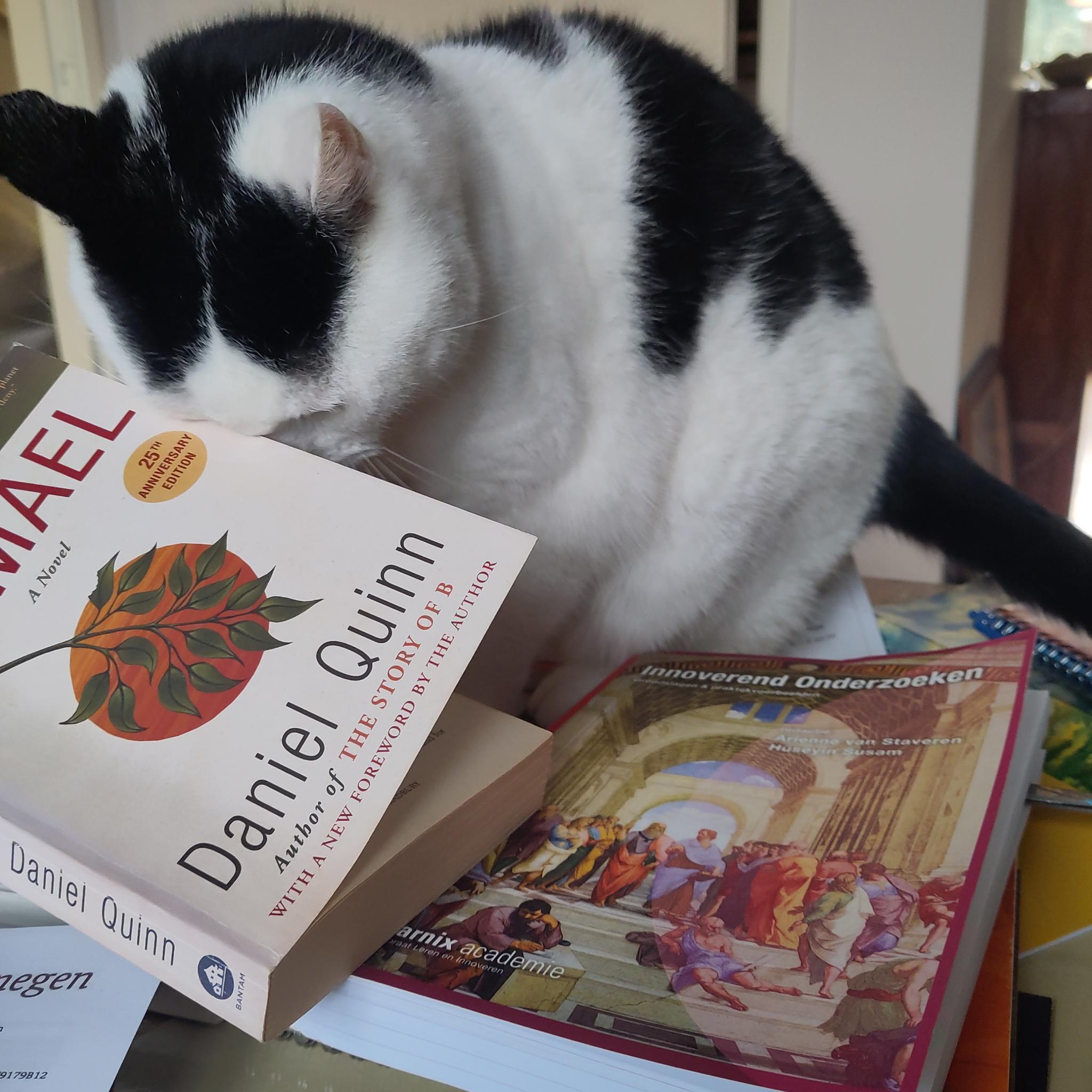
Ik las Ishmael. A novel van Daniel Quinn (voor het eerst verschenen in 1992) begin 2026 en besloot het te verweven met een deel van een eigen hoofdstuk (uit 2022), waarin ik posthumanisme verbind aan onderwijs. Lezenderwijs ontdek je hoe ze samenstromen, al zaten er 30 jaar tussen verschijning van beide teksten. Voor de leesbaarheid zijn de meeste bronverwijzingen helemaal op het eind te vinden en heb ik hier en daar mijn eigen tekst licht geredigeerd.
Op donderdag 23 augustus 1973 stapt de Zweedse Janne-Erik Olsson, net ontsnapt uit de gevangenis, de Sveriges Kreditbanken aan het plein Norrmalmstorg te Stockholm binnen om een overval te plegen. Hij eist geld, een ontsnappingsauto, de vrijlating van zijn gevangenismaatje Clark Olofsson en een uittocht met medeneming van zijn gijzelaars. Snel genoeg brengt de politie hem het geld, een blauwe Ford Mustang en Olofsson, maar laat niet toe dat zij de gijzelaars meenemen op hun uittocht. In de zes dagen die volgen houden de gijzelnemers Kristin Enmark, Birgitta Lundblad, Elisabeth Oldgren en Sven Safstrom gegijzeld in een kluis, terwijl de wereld gekluisterd aan de televisie toekijkt. Bij de bevrijding op 28 augustus 1973 blijken de gijzelaars sympathie voor hun gijzelnemers te hebben, en deze ook later nog te koesteren. Criminoloog en psychiater Nils Bejerot, die de politie destijds hielp, geeft uiteindelijk de naam ‘Stockholmsyndroom’ aan dit verschijnsel, dat eerder al bekend stond onder de naam emotional of traumatic bonding.
Uit onderzoek blijkt dat het Stockholmsyndroom ontstaat in een situatie van absoluut isolement en de combinatie van directe bedreiging met vriendelijk, troostend gedrag dat de dreiging nuanceert (of eigenlijk: ontkent). Hierin speelt cognitieve dissonantie een rol: het verhaal, dat niet blijkt te passen bij de werkelijkheid, wordt aangepast; niet aan de logica van de werkelijkheid maar aan de bestaande logica van de verteller. Slachtoffers die sympathie hebben voor degenen die hen misbruiken en intimideren, hanteren dit als overlevingsmechanisme.
“And have you had many pupils?”
“I’ve had four, and failed with all four.”
“Oh. Why did you fail?”
He closed his eyes to think for a moment. “I failed because I underestimated the difficulty of what I was trying to teach—and because I didn’t understand the minds of my pupils well enough.”
“I see,” I said. “And what do you teach?”
Ishmael selected a fresh branch from a pile at his right, examined it briefly, then began to nibble at it, gazing languidly into my eyes. At last he said, “On the basis of my history, what subject would you say I was best qualified to teach?”
I blinked and told him I didn’t know.
“Of course you do. My subject is: captivity.”
“Captivity.”
“That’s correct.”
I sat there for a minute, then I said, “I’m trying to figure out what this has to do with saving the world.”
Ishmael thought for a moment. “Among the people of your culture, which want to destroy the world?”
“Which want to destroy it? As far as I know, no one specifically wants to destroy the world.”
“And yet you destroy it, each of you. Each of you contributes daily to the destruction of the world.”
“Yes, that’s so.”
“Why don’t you stop?”
I shrugged. “Frankly, we don’t know how.”
“You’re captives of a civilizational system that more or less compels you to go on destroying the world in order to live.”
“Yes, that’s the way it seems.”
“So. You’re captives—and you have made a captive of the world itself. That’s what’s at stake, isn’t it?—your captivity and the captivity of the world.”
“Yes, that’s so. I’ve never thought of it that way.”
Nog een gijzelingsdrama, dit keer fictief. In de film Room groeit Jack samen met zijn moeder Joy op in een kamer.[1] Joy is jaren geleden ontvoerd door Old Nick, die Jack bij haar verwekt heeft. Als Jack vijf wordt, vindt Joy het tijd om samen te ontsnappen. Maar hoe leg je uit aan een kind, dat in één enkele kamer is opgegroeid, wat ‘buiten’ is? Zij weet wat het is, zij kent het nog; maar voor Jack is het concept zo nieuw, dat hij eerst hevige paniek moet overwinnen voordat hij kan geloven dat zoiets überhaupt bestaat: buiten. In een televisie-interview legt Joy dit als overlevingsstrategie voor hem uit:
– You chose to tell Jack that “Room” was the whole world. That there was nothing else.
– I wanted him to feel safe, that it was a great place for him to live.
Bij gebrek aan beter noem ik dit, ontleend aan de titel van de film, het ‘Roomsyndroom’. Ook hier weer absoluut isolement en vriendelijk, troostend gedrag. Het verschil is dat Jack lange tijd niet weet dat er een dreiging is, want hij weet niet beter. Ik zie hierin positieve psychologie als een pedagogische overlevingsstrategie: volwassenen stellen de wereld van het kind veiliger voor dan die is met het oog op het welbevinden van het kind, met als gevolg dat het kind angstig wordt als het die wereld moet verlaten.
“And do you still wonder if you’ve been lied to?”
“Yes, but not as desperately as I did then.”
“Not as desperately? Why is that?”
“Because I’ve found out that, as a practical matter, it doesn’t make any difference. Whether we’re being lied to or not, we still have to get up and go to work and pay the bills and all the rest.”
“Unless, of course, you all began to suspect you were being lied to—and all found out what the lie was.”
“What do you mean?”
“If you alone found out what the lie was, then you’re probably right—it would make no great difference, but if you all found out what the lie was, it might conceivably make a very great difference indeed.”
“True.”
“Then that is what we must hope for.”
Wat het Roomsyndroom ons leert, is dat ons eerste referentiekader bepalend is voor verdere betekenisgeving en dat het aangaan van referentiekaders die daarop volgen van ons een actie vragen waarvan we de uitkomst niet bij voorbaat kennen. Een sprong in het diepe, waarbij we niet weten waar we landen. Om die te nemen, moeten we eerst paniek overwinnen. Wat het Stockholmsyndroom ons leert, is dat we om te overleven in staat zijn de bron van wat ons bedreigt te omarmen, waardoor de gedachte om te springen niet eens bij ons opkomt. Ik breng deze syndromen te berde als voorbeelden van hoe ook wij gegijzeld kunnen zijn in onze referentiekaders, daar een haat-liefdeverhouding voor ontwikkelen, terwijl we ze beter gewoon de rug toekeren, ook al hebben we nog geen helder alternatief.
Om dit te laten zien, begin ik bij de variatie in referentiekaders. Hierdoor wordt later duidelijk hoe het heersende referentiekader geen noodzakelijke keuze hoeft te zijn: ook voor ons is er meer in de wereld dan de kamer waarin we zijn opgegroeid doet vermoeden.
“First, some vocabulary. Let’s have some names so we don’t have to go on talking about ‘the people of your culture’ and ‘the people of all other cultures.’ I’ve used various names with various pupils, but I’m going to try a new pair with you. You’re familiar with the expression ‘Take it or leave it.’ Using them in this sense, do the words takers and leavers have any heavy connotation for you?”
“I’m not sure what you mean.”
“I mean, if I call one group Takers and the other group Leavers, will this sound like I’m setting up one to be good guys and the other to be bad guys?”
“No. They sound pretty neutral to me.”
“Good. So henceforth I’m going to call the people of your culture Takers and the people of all other culture Leavers.”
[…]
“If Mother Culture were to give an account of human history using these terms, it would go something like this: ‘The Leavers were chapter one of a human history—a long and uneventful chapter. Their chapter of human history ended about ten thousand years ago with the birth of agriculture in the Near East. This event marked the beginning of chapter two, the chapter of the Takers. It’s true there are still Leavers living in the world, but these are anachronisms, fossils—people living in the past, people who just don’t realize that their chapter of human history is over.’”
“Right.”
“This is the general shape of human history as it’s perceived in your culture.”
“I would say so.”
“As you’ll come to see, what I’m saying is quite different from this. The Leavers are not chapter one of a story in which the Takers are chapter two.”
“Say that again?”
“I’ll say it differently. The Leavers and the Takers are enacting two separate stories, based on entirely different and contradictory premises. This is something we’ll be looking at later, so you don’t have to understand it right this second.”
“Okay.”
[…]
“What have people been told that keeps them from becoming excited, that keeps them relatively calm when they view the catastrophic damage they’re inflicting on this planet?”
“I don’t know.”
“They’ve been told an explaining story. They’ve been given an explanation of how things came to be this way, and this stills their alarm. This explanation covers everything, including the deterioration of the ozone layer, the pollution of the oceans, the destruction of the rain forests, and even human extinction—and it satisfies them. Or perhaps it would be more accurate to say that it pacifies them. They put their shoulders to the wheel during the day, stupefy themselves with drugs or television at night, and try not to think too searchingly about the world they’re leaving their children to cope with.”
[…]
“This boggles my mind. I don’t know any such story. Not any single story.”
“It’s a single, perfectly unified story. You have to think mythologically.”
“What?”
“I’m talking about your culture’s mythology, of course. I thought that was obvious.”
“It wasn’t obvious to me.”
“Any story that explains the meaning of the world, the intentions of the gods, and the destiny of man is bound to be mythology.”
“That may be so, but I’m not aware of anything remotely like that. As far as I know, there’s nothing in our culture that could be called mythology, unless, you’re talking about Greek mythology or Norse mythology or something like that.”
“I’m talking about living mythology. Not recorded in any books—recorded in the minds of people of your culture, and being enacted all over the world even as we sit here and speak of it.”
“Again, as far as I know, there’s nothing like that in our culture.”
[…]
“Then I’ll spell it out. You’re looking for your own culture’s creation myth.”
I stared at him balefully. “We have no creation myth,” I said. “That’s a certainty.”
Ik begin bij wat we allemaal gemeen hebben: we zijn levende wezens. Levende wezens zijn gebaat bij het maken van onderscheidingen of distincties. Dat doen we niet alleen door hoe onze lichamen in elkaar zitten en hoe we onszelf als levend wezen ervaren in wat ik bij gebrek aan beter maar even een ‘hiernu’ noem. Dat doen we ook door wat we van elkaar leren omdat we ons leven samen met anderen in gedeelde hiernu’s samenbrengen. Dit hiernu is dynamisch. Bronnen van dynamiek zijn onder andere (naast bijvoorbeeld ecologische veranderingen) onze eigen distincties. Deze kunnen hiërarchische relaties creëren, waardoor we een voorkeur voor het een hebben en het ander minderwaardig vinden, en ze kunnen minder waardegeladen zijn. Ze zijn daarmee niet alleen hiernu-relevant, maar ook zelf inzet van strijd of samenwerking. Ze vormen de context waarin de ene generatie de volgende generaties relevante wetenswaardigheden over het hiernu leert, bijvoorbeeld in onderwijs.
“What’s that?” I said when I arrived the following morning. I was referring to an object resting on the arm of my chair.
“What does it look like?”
“A tape recorder.”
“That’s exactly what it is.”
“I mean, what’s it for?”
“It’s for recording for posterity the curious folktales of a doomed culture, which you are going to tell me.”
I laughed and sat down. “I’m afraid I haven’t as yet found any curious folktale to tell you.”
“My suggestion to look for a creation myth bore no fruit?”
“We have no creation myth,” I said again. “Unless you’re talking about the one in Genesis.”
“Don’t be absurd. If an eight-grade teacher invited you to explain how all this began, would you read the class the first chapter of Genesis?”
“Certainly not.”
“Then what account would you give them?”
“I could give them an account, but it certainly wouldn’t be a myth.”
“Naturally you wouldn’t consider it a myth. No creation story is a myth to the people who tell it. It’s just the story.”
“Okay, but the story I’m talking about is definitely not a myth. Parts of it are still in question, I suppose, and I suppose later research might make some revisions in it, but it’s certainly not a myth.”
“Turn on the tape recorder and begin. Then we’ll know.”
[…]
“And you, an intelligent and moderately well-educated person, would have me believe that this isn’t a myth?”
“What’s mythical about it?”
“I didn’t say there was anything mythical about it. I said it was a myth.”
I think I laughed nervously. “Maybe I don’t know what you mean by myth.”
“I don’t mean anything you don’t mean. I’m using the word in an ordinary sense.”
“Then it’s not a myth.”
“Certainly it’s a myth. Listen to it.” Ishmael told me to rewind the tape and play it back.
After listening to it, I sat there looking thoughtful for a minute or two, for the sake of appearances. Then I said, “It’s not a myth, you can put that in an eight-grade science text, and I don’t think there’s a school board anywhere that would quibble with it—leaving aside the Creationists.”
“I agree wholeheartedly. Haven’t I said that the story is ambient in your culture? Children assemble it from many media, including science textbooks.”
“Then what are you saying? Are you trying to tell me that this isn’t a factual account?”
“It’s full of facts, of course, but their arrangement is purely mythical.”
“I don’t know what you’re talking about.”
“You’ve obviously turned off your mind. Mother Culture has crooned you to sleep.”
I gave him a hard look. “Are you saying that evolution is a myth?”
“No.”
“Are you saying that man did not evolve?”
“No.”
“Then what is it?”
Ishmael looked at me with a smile. Then he shrugged his shoulders. Then he raised his eyebrows.
I stared at him and thought: I’m being teased by a gorilla. It didn’t help.
“Play it again,” he told me.
[…]
“You’re really not thinking, I’m afraid. You’ve recited a story you’ve heard a thousand times, and now you’re listening to Mother Culture as she murmurs in your ear: ‘There, there, my child, there’s nothing to think about, nothing to worry about, just listen to my voice and go to sleep, go to sleep, go to sleep … .’”
Descola laat zien dat er vier soorten ontologie, dus ideeën over mens en wereld, te onderscheiden zijn naar gelang innerlijk leven (ziel, psyche, emotie, bewustzijn) en lichamelijke kenmerken (vorm, materie) van wezens gedeeld worden of niet. In een animistische ontologie delen alle wezens hetzelfde innerlijk leven, maar hebben ze verschillende lichamen. Stenen, planten en dieren hebben overeenkomstige – menselijke of mensachtige – trekken en ervaringen, en ze delen vergelijkbare sociale verschijnselen als leiderschap, cultuur, taal en spel. Hierover is uitgebreid geschreven door Abram in de context van sjamanen als bemiddelaars tussen de menselijke samenleving en de grotere samenleving van alle wezens, maar we kennen de sjamanistische figuur van shapeshifter ook uit oud-Europese verhalen, zoals de weerwolf.
In Descola’s totemistische ontologie delen wezens sommige elementen van zowel het innerlijke als het lichamelijke leven, maar de samenstelling is gedifferentieerd en kan daarmee verschillen tussen individuen, afhankelijk van waar ze zijn en welk leven ze continueren. Het geheugen van het leven heeft niets temporeels, maar zit in het landschap dat steeds opnieuw als levend hiernu aangeroepen kan worden, bijvoorbeeld zoals Australische Aboriginals zingend doen. De totemdieren uit de Noorse en Germaanse kosmologie zijn ook voorbeelden.
Volgens gemeenschappen met een analogische ontologie verschillen wezens in zowel innerlijke levens als lichamelijke kenmerken radicaal van elkaar, zowel onderling als binnen de soort (de ene menselijke gemeenschap is de andere niet), maar delen ze aanknopingspunten die hen verbinden in een groter geheel. Je ziet dit terug in de scala naturae van Aristoteles, waarin alle wezens een vaste plek hebben met de mens bovenaan, maar ook in de Chinese geneeskunde, de Mexicaanse rangen- en standensamenleving, Europese alchemie en, van latere datum en andere strekking, de functionalistische sociologie.
“Why was the world and the universe incomplete without man? Why did the world and the universe need man?”
“I don’t know.”
“Well, think about it. Think about the world without man. Imagine the world without man.”
“Okay,” I said, and closed my eyes. A couple minutes later I told him I was imagining the world without man.
“What’s it like?”
“I don’t know. It’s just the world.”
“Where are you?”
“What do you mean?”
“Where are you looking at it from?”
“Oh. From above. From outer space.”
“What are you doing up there?”
“I don’t know.”
“Why aren’t you down on the surface?”
“I don’t know. Without man on it … I’m just a visitor, an alien.”
“Well, go on down to the surface.”
“Okay,” I said, but after a minute I went on to say, “That’s interesting. I’d rather not go down there.”
“Why? What’s down there?”
I laughed. “The jungle is down there.”
“I see. You mean, ‘Nature, red in tooth and claw … Dragons of the prime that tare each other in their slime.’”
“That’s it.”
“And what would happen if you did go down there?”
“I’d be one of the ones the dragons were tearing in their slime.”
I opened my eyes to see Ishmael nodding. “And it is at this point that we begin to see where man fits into the divine scheme. The gods didn’t mean to leave the world a jungle, did they?”
“You mean in our mythology? Certainly not.”
“So: Without man, the world was unfinished, was just nature, red in tooth and claw. It was chaos, in a state of primeval anarchy.”
“That’s right. That’s it exactly.”
“So it needed what?”
“It needed someone to come in and … straighten it out. Someone to put it in order.”
“And what sort of person is it who straightens things out? What sort of person takes anarchy in hand and puts it in order?”
“Well … a ruler. A king.”
“Of course. The world needed a ruler. It needed man.”
“Yes.”
“So now we have a clearer idea what this story is all about: The world was made for man, and man was made to rule it.”
“Yes. That’s very obvious now. Everyone understands that.”
“And this is what?”
“What?”
“Is this fact?”
“No.”
“Then what is it?”
“It’s mythology,” I said.
“Of which no trace is to be found in your culture.”
“That’s right.”
Once again Ishmael stared at me glumly through the glass.
“Look,” I said after a bit. “The things you’re showing me, the things you’re doing, are … almost beyond belief. I know that. But it’s just not in me to leap out of my chair while striking my brow and crying, ‘My God, this is incredible!’”
He wrinkled his forehead thoughtfully for a moment before saying: “What’s wrong with you then?”
He seemed so genuinely concerned that I had to smile.
“All frozen inside,” I told him. “An iceberg.”
He shook his head, sorry for me.
In Descola’s naturalistische ontologie, tot slot, delen we als levende wezens onze lichamelijke levens (de natuurwetenschappelijke wetten gelden voor ons allemaal), maar verschillen we radicaal qua innerlijke levens. Deze ontologie is dualistisch, dat wil zeggen dat twee elementen van een paar als onverenigbaar worden voorgesteld, omdat ze niet tot elkaar te herleiden zijn. Hierin vinden we radicale verschillen tussen alle soorten, binnen de menselijke soort tussen groepen mensen, binnen groepen mensen tussen individuen en binnen individuen tussen lichaam en geest. De basiswet hiervoor is door Aristoteles geformuleerd als ‘de wet van het uitgesloten midden’: iets is het een of het ander, nooit allebei. Deze ontologie zie je eigenlijk alleen terug in wat ‘het westers denken’ is gaan heten, dat zijn formele oorsprong heeft in de Griekse filosofie en de joods-christelijke religies en later vanaf de renaissance is omgewerkt in de verlichting en de moderniteit.
“The world would not meekly submit to man’s rule, so he had to do what to it?”
“What do you mean?”
“If the king comes to a city that will not submit to his rule, what does he have to do?”
“He has to conquer it.”
“Of course. In order to make himself the ruler of the world, man first had to conquer it.”
“Good lord,” I said—and nearly leaped up of my chair while striking my brow and all the rest.
“Yes?”
“You hear this fifty times a day, you can turn on the radio or the television and hear it every hour. Man is conquering the deserts, man is conquering the oceans, man is conquering the atom, man is conquering the elements, man is conquering outer space.”
Ishmael smiled. “You didn’t believe me when I said that this story is ambient in your culture. Now you see what I mean. The mythology of your culture hums in your ears so constantly that no one pays the slightest bit of attention to it. Of course man is conquering space and the atom and the deserts and the oceans and the elements. According to your mythology, this is what he was born to do.”
“Yes. That’s very clear now.”
Eigenlijk gaat het steeds om hoe gemeenschappen proberen om te gaan met tegenstrijdige keuzes die ontstaan door hiernu-dynamieken en de gedachte dat niet alles altijd tegelijkertijd kan. Dat zijn dus morele keuzes. Baggini maakt een ontologische indeling veelal langs de lijnen van hoe gemeenschappen betekenisgeven aan hun hiernu door de distincties die ze maken tussen bijvoorbeeld 1) lineaire, cyclische en geen-tijd, 2) atomische, relationele en non-zelven, en 3) harmonische, conflicterende en deugdensamenlevingen. De vraagstukken zijn vergelijkbaar, de antwoorden niet.
Pálsson maakt weer een andere indeling als het gaat om mens-wereldrelaties. In oriëntalistische en paternalistische samenlevingen heerst de mens over de natuur, respectievelijk als exploitant (koloniaal imperialisme) en beschermer (het christelijke rentmeesterschap, maar ook zogeheten natuurvolkeren). Hierin houden experts monologen over de natuur en legitimeren ze hun keuzes en handelen met die monologen.[2] In communale samenlevingen, zoals middeleeuws Europa, is er geen scheiding tussen menselijke samenlevingen en de natuur (de middeleeuwse betekenis van ’individu’ verwijst naar die ondeelbaarheid, niet naar het ondeelbare individu zoals vandaag vaak verschijnt). Hierin zijn mensen in dialoog met de natuur en kiezen ze hun handelingen op grond van samenwerking met andere wezens.[3] In de animistische, totemistische, analogische en communale ontologie zijn distincties leidend in hoe mensen samenwerken, onderling en met andere wezens. Anders is dat in de naturalistische, oriëntalistische en paternalistische ontologie: daarin creëren de distincties hiërarchische relaties en plaatsen mensen zich boven de andere wezens, met daaraan verbonden het privilege tot plundering dan wel de zorgplicht.
“I think you can figure it out. So far we have this much: The world was made for man to conquer and under human rule it was meant to become a paradise. This clearly has to be followed by a ‘but’. It has always been followed by a ‘but’. This is because the Takers have always perceived that the world was far short of the paradise that it was meant to be.”
“True. Let me see … How’s this: The world was made for man to conquer and rule, but his conquest turned out to be more destructive than was anticipated.”
“You’re not listening. The ‘but’ was part of the story long before your conquest became globally destructive. The ‘but’ was there to explain all the flaws in your paradise—warfare and brutality and poverty and injustice and corruption and tyranny. It’s still there today to explain famine and oppression and nuclear proliferation and pollution. It explained World War II, and if it ever has to, it will explain World War III.”
I looked at him blankly.
“This is a commonplace. Any third-grader could supply it.”
“I’m sure you’re righty, but I don’t see it yet.”
“Come, think. What went wrong here? What has always gone wrong here? Under human rule, the world should have become a paradise, but …”
“But people screwed it up.”
“Of course. And why did they screw it up?”
“Why?”
“Did they screw it up because they didn’t want a paradise?”
“No. The way it’s seen is … they were bound to screw it up. They wanted to turn the world into a paradise, but, being human, they were bound to screw it up.”
“But why? Why, being human, were they bound to screw it up?”
“It’s because there’s something fundamentally wrong with humans. Something that definitely works against paradise. Something that makes people stupid and destructive and greedy and shortsighted.”
“Of course. Everyone in your culture knows this. Man was born to turn the world into a paradise, but tragically he was born flawed. And so his paradise has always been spoiled by stupidity, greed, destructiveness, and shortsightedness.”
“That’s right.”
Ik heb op basis van Baggini, Descola en Pálsson variatie laten zien in hoe menselijke samenlevingen distincties maken. Mijn doel was te laten zien dat daarin variatie zit en dat distincties valide zijn naar gelang hun hiernu. Dat verdwijnt wel eens uit het zicht in teksten die als vanzelfsprekend distincties creëren zonder deze te plaatsen tegen een achtergrond van pluralisme, alsof er geen alternatieven zijn. Dit bedoel ik met die gijzeling: we worden vastgehouden in een enkelvoudig, neutraal aandoend referentiekader (Jacks kamer). Dat is jammer, omdat juist onderlinge vergelijkingen leerzaam zijn. De hier aangehaalde auteurs concluderen dan ook dat universalisme, ofwel de aanname dat één ontologie voor elke plaats en elke tijd en iedereen waar is (ook al geloven we in ons eigen hiernu wat anders), een denkfout is. De opdracht is dat we een transparochiaal perspectief nemen.[4]
“How did the Takers come to the conclusion that there’s something fundamentally wrong with humans? What evidence were they looking at?”
“I don’t know.”
“I think you’re being purposely dense. They were looking at the evidence of human history.”
“True.”
“And when did human history begin?”
“Well … three million years ago.”
Ishmael gave me a disgusted look. “Those three million years were only very recently tacked onto human history, as you very well know. Before that, it was universally assumed that human history began when?”
“Well, just a few thousand years ago.”
“Of course. In fact, among the people of your culture, it was assumed that the whole of human history was your history. No one had the slightest suspicion that human life extended beyond your reign.”
“That’s so.”
“So when the people of your culture concluded that there’s something fundamentally wrong with humans, what evidence were they looking at?”
“They were looking at the evidence of their own history.”
“Exactly. They were looking at a half of one percent of the evidence, taken from a single culture. Not a reasonable sample on which to base such a sweeping conclusion.”
“No.”
“There’s nothing fundamentally wrong with people. Given a story to enact that puts them in accord with the world, they will live in accord with the world. But given a story to enact that puts them at odds with the world, as yours does, they will live at odds with the world. Given a story to enact in which they are the lords of the world, they will act like lords. And, given a story to enact in which the world is a foe to be conquered, they will conquer it like a foe, and one day, inevitably, their foe will lie bleeding to death at their feet, as the world is now.”
Tegenover het of-of aspect van het naturalistisch denken geven state of the art wetenschappelijke grondslagen aanleiding om in en-en te gaan denken: die stellen – ook empirisch – vast dat er geen strikte grenzen zijn en dat onze ervaringen daarmee voortkomen uit de grenzen (distincties dus) die wij zelf maken. De ultieme consequentie daarvan is, dat we ‘het individu’ als betekenisvolle eenheid van analyse moeten loslaten. Let op: daarmee zeg ik niet dat we het individu opheffen; dit verliest alleen zijn legitimiteit van alles verklarende factor. Kort gezegd past de recente wetenschappelijke kennis over wie of wat we zijn niet bij de naturalistische, maar het beste bij een totemistische ontologie. Dat kan een nieuw licht werpen op hoe en waar we leren.
Bij het Roomsyndroom gold voor Jack de kamer als eerste referentiekader. Meer kende hij niet. Als ik kijk naar onze eerste kamer, namelijk de cultuur waarin we opgroeien met onderwijs als exponent daarvan, dan zie ik een accent op individualiseren (de wereld opdelen in objecten die door hun essentie ondeelbaar zijn). In ons onderwijs is het analyseren zoals dat in de oud-Griekse scholè gedaan werd dominant, ook al zijn de randvoorwaarden daarvoor veranderd.[5] We leren in het westers onderwijs al vroeg en jong om onderscheid te maken en de wereld langs essentialistische scheidslijnen (dit is niet dat) in te delen. Wat we niet snel leren, is om dat wat die analyse ons leert over de afzonderlijke onderdelen, in te zetten om grotere gehelen beter te begrijpen (die zijn genest, waardoor meerlagigheid of meervoudigheid ontstaat). We laten onze kennis na de analyse als het ware in brokjes achter. Dode brokjes, die we aan jongere generaties doorgeven.[6] Om hieraan te ontsnappen, moeten we een welhaast restauratieve beweging maken richting een ‘integratieve pedagogiek’: een pedagogiek die de ingesleten dichotomieën in ons denken opheft, omdat die geen recht doen aan de complexiteit van de werkelijkheid.[7] In onderwijs betreft dit drie vragen: welk denken leren we aan toekomstige generaties; welk denken volgen we om hen hierin te helpen; welk denken helpt ons dit te onderzoeken? Hierboven heb ik met de variatie in ontologie laten zien dat we keuzes hebben. Toch wordt veelal de naturalistische keuze als bijna vanzelfsprekend uitgangspunt gekozen.
“You know how to split atoms, how to send explorers to the moon, how to splice genes, but you don’t know how people ought to live.”
“That’s right.”
“Why is that? What does Mother Culture have to say?”
“Ah,” I said, and closed my eyes. And after a minute or two: “Mother Culture says it’s possible to have certain knowledge about things like atoms and space travel, but there’s no such thing as certain knowledge about how people should live. It’s just not available, and that’s why we don’t have it.”
“I see. And having listened to Mother Culture, what do you say?”
“In this case, I have to say that I agree. Certain knowledge about how people ought to live is just not out there.”
[…]
“You’re quite sure about all this. There’s simply no way of finding that out. It’ll be a question of taking a vote.”
“Absolutely sure.”
“How do you come by this assurance?”
“I don’t know. Certain knowledge about how to live is … unobtainable in any of the ways we derive certain knowledge. As I say, it’s just not out there.”
Naturalistisch denken als eerste referentiekader zet zich voort als enige referentiekader als Jacks moeder Joy niet vindt dat het tijd wordt daaraan te ontsnappen. Wie op zijn of haar levenspad geen Joy tegenkomt, zal niet spontaan de kamer verlaten, want die is onwetend van het feit dat er meer is. Dat roept de vraag op in hoeverre mensen die het westers onderwijs nooit verlaten, bijvoorbeeld doordat ze er als leraar of schoolleider in gaan werken of onderzoek naar gaan doen, te weten komen over andere mogelijke soorten ontologie en hun innig verbonden epistemologie. Ik denk dat ze dat wel doen, want ons hiernu is geen afgesloten kamer maar een wereld waarin we vooral variatie aantreffen. Bovendien hebben we door ons lichaam voortdurend de ervaring van emergentie.[8] Dat maakt de inrichting van onderwijs als een capsule waarin we doen alsof dit niet zo is, een vreemde keuze, tenzij we kijken naar de oorsprong ervan: de Griekse scholè. Het hiernu van de Grieken in hun scholè was er een van vergaande privileges: men kon zich onttrekken aan maatschappelijke verplichtingen.
“Have any of you ever looked out there?”
I snickered.
“Has anyone ever said, ‘Well, we have certain knowledge about all these other things, why don’t we see if any such knowledge can be found about how to live?’ Has anyone ever done that?”
“I doubt it.”
“Doesn’t that seem strange to you? Considering the fact that this is by far the most important problem mankind has to solve—has ever had to solve—you’d think there would be a whole branch of science devoted to it. Instead, we find that not a single one of you has ever wondered whether any such knowledge is even out there to be obtained.”
“We know it’s not there.”
“In advance of looking, you mean?”
“That’s right.”
“Not a very scientific procedure for such a scientific people.”
“True.”
Ons hiernu is anders: wij zitten midden in een klimaatcrisis, mede veroorzaakt door systemen waarin besluiten worden genomen door mensen uit tradities van de naturalistische ontologie.[9] Wij kunnen ons daardoor niet meer onttrekken aan verplichtingen, zij zijn ons hiernu. De klimaatcrisis is een crisis van ons leren. Het aangaan van die verplichtingen vraagt om een pedagogiek van integratie, niet separatie.[10] Stug door willen geloven dat de naturalistische ontologie valide is, is een vorm van Stockholmsyndroom: je vreest haar gevolgen, houdt van haar privileges en blijft omdat je geen alternatief ziet. Ik schreef bij het Roomsyndroom dat het loslaten van bestaande referentiekaders een sprong in het diepe is waarbij we niet weten waar we landen. Het eerste referentiekader, van bijvoorbeeld ‘het westers denken’, biedt veiligheid en plezier. Liever neem ik de reactie van Jack in zijn confrontatie met het ongewisse serieus: als we echt buiten de lijnen van het vertrouwde individu-denken willen komen, dan hebben we om te gaan met gevoelens van paniek. Anders dan moed en waagstuk, is paniek een emotie die thuishoort in een hiernu dat niet meer te begrijpen valt.
“We’ve spent a lot of today looking at one of your most impressive monuments—an axiom stating that there is no way to obtain any certain knowledge about how people ought to live. Mother Culture offers this for acceptance on its own merits, without proof, since it is inherently unprovable.”
“True.”
“And the conclusion you draw from this axiom is …?”
“Therefore there is no point in looking for such knowledge.”
“That’s right. According to your maps, the world of thought is coterminous with your culture. It ends at the border of your culture, and if you venture beyond that border, you simple fall off the edge of the world. Do you see what I mean?”
“I think so.”
Is innoverend onderzoek een kwestie van de kamer schilderen of naar buiten gaan, je hiernu-aandacht ook richten op wezens met andere soorten ontologie en epistemologie? Dat de naturalistische ontologie vaak wordt vereenzelvigd met ‘het westers denken’ betekent niet dat wij er in het westen – net als Joy door Old Nick – door gegijzeld hoeven te zijn en te doen alsof dit een “safe and great place” is – zoals Joy Jack voorhoudt – want dat is het niet meer. Het loont de moeite je te verdiepen in de variatie die de wereld biedt. Volgens Baggini denkt 12 procent ‘westers’ en ik durf de stelling aan dat er van de resterende 88 procent ook mensen op westers grondgebied rondlopen. Dat die variatie onzichtbaar blijft, is niet doordat ze er niet is, maar doordat ze binnen het officiële discours (onze hele maatschappij is erop ingericht) ontoelaatbaar is; het is daardoor alsof Old Nick stilzwijgend aan tafel kan blijven aanschuiven bij een nieuwe Joy die geïntimideerd is en een nieuwe Jack die nog niet van ‘buiten’ weet. Hier kunnen we iets in gaan betekenen.
“Tomorrow we’ll screw up our courage and cross that border. And as you’ll see, we will not fall off the edge of the world. We’ll just find ourselves in new territory, in territory never explored by anyone in your culture, because your maps say it isn’t there—and indeed can’t be there.”
[…]
“Okay. My mind is open, but I can’t imagine any way in the world you’re going to accomplish that.”
“What’s the law of gravity?” Ishmael asked, once again startling me with an apparent change of subject.
“The law of gravity? Well, the law of gravity is … every particle in the universe is attracted to every other particle, and this attraction varies with the distance between them.”
“And that expression of the law was read where?”
“What do you mean?”
“It was derived by looking at what?”
“Well … at matter, I suppose. The behavior of matter.”
“It wasn’t derived by a close study of the habits of bees.”
“No.”
“If you want to understand the habits of bees, you study bees, you don’t study mountain-building.”
“That’s right.”
“And if you had the strange notion that there might be a set of laws about how to live, where would you look for it?”
“I don’t know.”
“Would you look into the heavens?”
“No.”
“Would you delve into the realm of subatomic particles?”
“No.”
“Would you study the properties of wood?”
“No.”
“Take a wild guess.”
“Anthropology?”
“Anthropology is a field of study, like physics. Did Newton discover the law of gravity by reading a book on physics? Is that where the law was written?”
“No.”
“Where was it written?”
“In matter. In the universe of matter.”
“So, again: If there is a law pertaining to life, where will we find it written?”
“I suppose in human behavior.”
“I have amazing news for you. Man is not alone on this planet. He is part of a community, upon which he depends absolutely. Have you ever had any suspicions to that effect?”
It was the first time I’d seen him raise a single eyebrow.
“You don’t have to be sarcastic,” I told him.
“What’s the name of this community, of which man is only one member?”
“The community of life.”
“Bravo. Does it seem at all plausible to you that the law we’re looking for could be written in this community?”
“I don’t know.”
“What does Mother Culture say?”
I closed my eyes and listened for a while. “Mother Culture says that if there were such a law it wouldn’t apply to us.”
“Why not?”
“Because we’re so far above all the rest of that community.”
“I see. And can you think of any other laws from which you are exempt because you’re humans?”
“What do you mean?”
“I mean that cows and cockroaches are subject to the law of gravity. Are you exempt?”
“No.”
“Are you exempt from the laws of aerodynamics?”
“No.”
“Genetics?”
“No.”
“Thermodynamics?”
“No.”
“Can you think of any laws at all from which humans are exempt?”
“Not offhand.”
“Let me know if you do. That will be real news.”
“Okay.”
“But meanwhile, if there does happen to be a law that governs behavior in the community of life in general, humans would be exempt from it.”
“Well, that’s what Mother Culture says.”
“And what do you say?”
“I don’t know. I don’t see how a law for turtles and butterflies could be of much relevance to us. I assume that turtles and butterflies follow the law you’re talking about.”
“That’s right, they do. As to relevance, the laws of aerodynamics weren’t always relevant to you, were they?”
“No.”
“When did they become relevant?”
“Well … when we wanted to fly.”
“When you wanted to fly, the laws governing flight become relevant.”
“Yes, that’s right.”
“And when you’re on the brink of extinction and want to live for a while longer, the laws of life might conceivably become relevant.”
“Yes, I suppose they might.”
Mijn eigen paniek bracht me naar het posthumanisme: de poging om de mens te decentraliseren in het wereldgebeuren en aandacht te hebben voor andere levende en niet-levende wezens die onze planeet (nog) rijk is. Daarbij, maar dat is persoonlijk, laat ik me ook inspireren door hoe andere dieren leren (zoö-epistemologie) en de flora samenwerkt, want dat maakt mijn eigen aandacht voor het emergente des te rijker.
Ishmael nodded. “Diversity is a survival factor for the community itself. A community of a hundred million species can survive almost anything short of total global catastrophe. Within that hundred million will be thousands that could survive a global temperature drop of twenty degrees—which would be a lot more devastating than it sounds. Within that hundred million will be thousands that could survive a global temperature rise of twenty degrees. But a community of hundred species or a thousand species has almost no survival value at all.”
“True. And diversity is exactly what’s under attack here. Every day dozens of species disappear as a direct result of the way the Takers compete outside the law.”
“Now that you know there’s a law involved, does it make a difference in the way you view what’s going on?”
“Yes, I no longer think of what we’re doing as a blunder. We’re not destroying the world because we’re clumsy. We’re destroying the world because we are, in a very literal and deliberate way, at war with it.”
[…]
“You want to know what this has to do with anything,” he said with a nod. “It has this to do with anything: The world of the Takers is one vast prison, and except for a handful of Leavers scattered across the world, the entire human race is now inside that prison.”
[…]
“There is one significant difference between the inmates of your criminal prisons and the inmates of your cultural prison: The former understand that the distribution of wealth and power inside the prison has nothing to do with justice.”
I blinked at him for a while, then asked him to explain. “In your cultural prison, which inmates wield the power?”
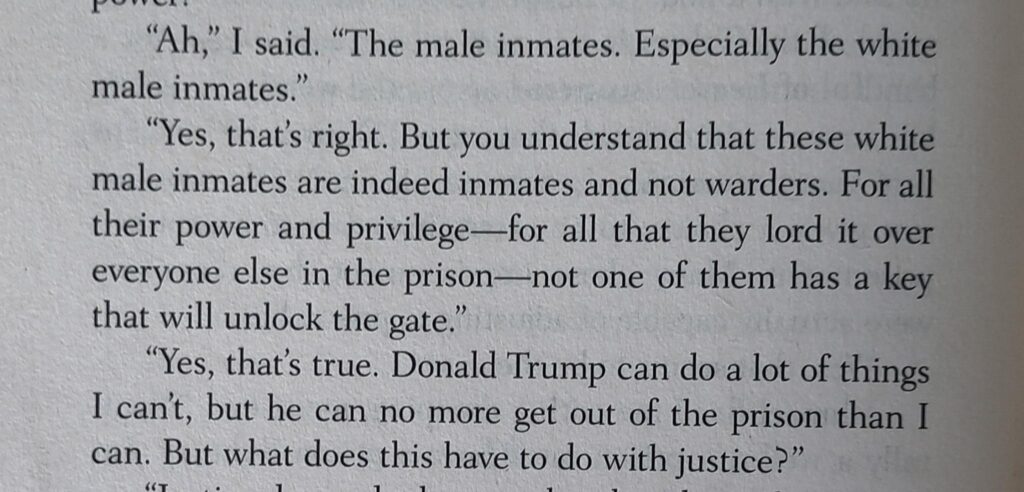
“Justice demands that people other than white males have power in the prison.”
“Yes, I see. But what are you saying? That this isn’t true?”
“True? Of course it’s true that males—and, as you say, especially white males—have called the shots inside the prison for thousands of years, perhaps even from the beginning. Of course it’s true that this is unjust. And of course it’s true that power and wealth within the prison should be equitably redistributed. But it should be noted that what is crucial to your survival as a race is not the redistribution of power and wealth within the prison but rather the destruction of the prison itself.”
Wat zou er gebeuren als het eerste referentiekader van toekomstige generaties een pluralistische epistemologie wordt? Ik zie ernaar uit om met andere belangstellenden hiernaar onderzoek te doen, uiteraard uitgaand van een vergelijkbaar pluralisme in onderzoeksstrategieën.
Tot zover de samenstroom van twee teksten tot een bijna naadloos gevoerde dialoog, al zaten er 30 jaar tussen verschijnen. Ik heb rijkelijk geput uit de tekst van Quinn, ook om daarmee nieuwsgierig te maken naar het boek. Ishmael was na publicatie in 1992 een bestseller en omdat ik denk dat de lessen van de gorilla niets aan relevantie hebben ingeboet, breng ik het via deze weg opnieuw onder de aandacht. Juist om aan te sporen het boek zelf te lezen heb ik hier niet verklapt wat de wet is waar Ishmael het over heeft – maar ik kan wél verklappen dat ik hier in mijn werk mee verder ga. Ishmael is weliswaar fictie, maar daarmee is wat hij zegt geen onzin. Waar ik pluralisme beschrijf en ook als studiehouding aanraad, hanteert Ishmael een dualistisch onderscheid tussen Takers en Leavers. Binnen die laatste is volgens hem variatie te vinden, maar wat hen bindt is dat ze op dat ene aspect van die ene wet niet als Takers in het leven staan – of beter: als Takers tegen het leven ingaan. Kort en goed is het verhaal van de Takers wetenschappelijk gezien over de houdbaarheidsdatum, alle technologische prestaties ten spijt wanneer deze de wet van die gemeenschap blijven overtreden. Mother Culture, Stockholmsyndroom, Roomsyndroom, … wie de gevangenis ziet, kan haar niet meer wegdenken. Maar dat is niet het einde van het verhaal voor mij. Eerder, in 2021, schreef ik over mijn eigen wakker worden in de klimaatcrisis. Wie net als ik in een Taker cultuur geboren is, kan volgens mij bij ontwaken niet zo maar even Leaver worden. Er is een verschil tussen niet meer kunnen wegdenken en ongedaan maken. Dat laatste kan niet, maar wat wel kan is levenslang vorm proberen te geven aan niet-Taker-zijn. Studie hoort daarbij, gewoon om beter anders te kunnen kiezen. Ook al is dat binnen een kapitalistische, geopolitieke anti-ecologie verdomde moeilijk, voor mij is de slogan ‘moedig groenwaarts’ helder, betekenisvol en niet-onderhandelbaar. Zo vertaal ik voor mezelf het antwoord op hoe te leven.
Ik sloot mijn eigen hoofdstuk af met een uitnodiging. Inmiddels hebben tientallen mensen hieraan gehoor gegeven. Ik herhaal deze uitnodiging graag op deze plek. Herken je iets van de analyse hierboven? En ben je of wil je aan het werk met deze ideeën en uitgangspunten, dit verhaal? Ik hoor er graag meer over via floorbasten@orleon.nl.
Primaire teksten
Basten, Floor (2022). Posthumanisme in onderwijsonderzoek. In Ariënne van Staveren & Hüseyin Susam (red.) Innoverend Onderzoeken. Grondslagen & praktijkvoorbeelden (123-138). Marnix Academie Utrecht.
Quinn, Daniel (2017). Ishmael. A novel. Bantam Books. Meer info over dit boek vind je hier en je kunt er ook naar luisteren op Spotify.
Bronnen bij noten
[1] Guiney, E. (Producent), Gross, D. (Producent), & Abrahamson, L. (Regisseur). (2016). Room [Film]. Toronto: Pinewood Toronto Studios.
[2] Zie ook Bonnett, M. (2004). Retrieving nature. Education for a post-humanist age. Oxford, UK: Blackwell Publishing. Zie ook Collins, R. (1998). The sociology of philosophies. A global theory of intellectual change. Cambridge, MA: The Belknap Press of Harvard University Press.
[3] Zie ook Abram (1997) op de literatuurlijst.
[4] Zie ook Collins (1998) bij noot 2.
[5] Zie ook Ingold, T. (2018). Anthropology and/as Education. Londen: Routledge.
[6] Zie ook Ellsworth, E. (2005). Places of learning: Media, architecture, pedagogy. Londen: Routledge. Zie ook Ingold (2018) bij noot 5.
[7] Zie ook Lehtonen, A., Salonen, A., Cantell, H., & Riuttanen, L. (2018). A pedagogy of interconnectedness for encountering climate change as a wicked sustainability problem. Journal of Cleaner Production, 199, 860-867.
[8] Zie ook Bonnett (2004) bij noot 2.
[9] Zie bijvoorbeeld Van Baardewijk, J. K. (2018). The moral formation of business students: A philosophical and empirical investigation of the business student ethos (Proefschrift). Amsterdam, Vrije Universiteit Amsterdam. Zie ook White, J. (2020). Education in an uncertain future: Two scenarios. London Review of Education, 18 (2), 299–312.
[10] Zie ook Lethonen et al. (2018) bij noot 7.
Daarnaast ook
Abram, D. (1997). The spell of the sensuous. Perception and language in a more-than-human world. New York: Vintage Books.
Baggini, J. (2018). How the world thinks: a global history of philosophy. Londen: Granta Books.
Descola, P. (2005). Par-delà nature et culture (Vol. 1). Parijs : Gallimard.
Pálsson, G. (1996). Human-environmental relations: orientalism, paternalism and communalism. In Ph. Descola & G. Pálsson (eds.), Nature and society. Anthropological perspectives (pp. 63-81). Londen: Routledge.
Citaten en paginanummers uit primaire teksten (zie hierboven)
Op donderdag 23 … dit als overlevingsmechanisme. p. 123.
“And have you … it that way.” p. 27-28.
Nog een gijzelingsdrama, … wereld moet verlaten. p. 124.
“And do you … must hope for.” p. 30.
Wat het Room … opgegroeid doet vermoeden. p. 124.
“First, some vocabulary. … “That’s a certainty.” p. 40-49.
Ik begin bij … bijvoorbeeld in onderwijs. p. 125.
“What’s that?” I … go to sleep … .’” p. 53-57.
Descola laat zien … de functionalistische sociologie. p. 125-126.
“Why was the … sorry for me. p. 75-77.
In Descola’s naturalistische … en de moderniteit. p. 126.
“The world would … very clear now.” p. 78.
Eigenlijk gaat het … wel de zorgplicht. p. 126-127.
“I think you … “That’s right.” p. 86-87.
Ik heb op … transparochiaal perspectief nemen. p. 127.
“How did the … world is now.” p. 88-89.
Tegenover het of-of … waar we leren. P. 131-132.
Bij het Room … vanzelfsprekend uitgangspunt gekozen. p. 134.
“You know how … not out there.” p. 92.
Naturalistisch denken als … aan maatschappelijke verplichtingen. p. 134-135.
“Have any of … scientific people.” “True.” p. 93.
Ons hiernu is … te begrijpen valt. p. 135.
“We’ve spent a … “I think so.” p. 96.
Is innoverend onderzoek … in gaan betekenen. p. 135-136.
“Tomorrow we’ll screw … suppose they might.” p. 96-105.
Mijn eigen paniek … des te rijker. p. 136
Ishmael nodded. “Diversity … war with it. p. 136.
You want to … the prison itself.” p. 271-272.
Wat zou er … pluralisme in onderzoeksstrategieën. p. 136.